Albert Einstein) Biography of Albert Einstein (Albert Einstein) Albert Einstein) (14.03.1879-18.04.1955) – Albert Einstein (Albert Einstein) (14.03.1879-18.04.1955) – an outstanding theoretical physicist, one of the founders of modern physics. Born in Ulm. Fourteen years later he moved to Switzerland, where he graduated from Zurich Polytechnic. In 1902-1908 he worked as an expert at the patent office in Bern, in the years 1909-1913 – Professor of the Zurich Polytechnic, in the years 1914-1933 – Professor of the University of Berlin and director of the Institute of Physics. After the establishment of the power of fascists persecuted and forced to leave Germany. In 1933 he moved to the US, where he worked until his death at the Princeton Institute for Advanced Study. The creator of the special and general theories of relativity radically change the perception of space, time and matter. In 1905, in his article “On the Electrodynamics of Moving Bodies”has developed a framework of special relativity, setting out new laws of motion, which generalize Newtonian and passed them in the case of small velocities of the bodies. The basis of his theory put two postulates: the special principle of relativity, which is a generalization of the mechanical principle of relativity of Galileo to any physical phenomena (in all inertial frames of all physical processes – mechanical, electrical, thermal, optical, and others. – Proceed the same way), and the principle of the constancy of the speed light in a vacuum (the speed of light is independent of the movement of the light source or the observer and the same in all directions, that is the same in all inertial systems, and is equal to 30 billion cm / s). Both postulate and theory, based on them, have led to a breakdown of many established classical notions (absolute space and absolute time), was forced to revise a number of key provisions of the classical physics of Newton, set a new world view, a new space-time representation (with respect to length of time , simultaneity of events). However, this theory is not completely pushed laws set by classical mechanics and refined them in case of traffic at speeds commensurate with the speed of light in vacuum. Based on his theory, Albert Einstein in the same 1905 he discovered the law relating mass and energy. It showed that the mass is a measure of the energy contained in the bodies. This relationship is the basis of Einstein’s calculation of the energy balance of nuclear reactions, the basis of all nuclear physics. All the statements and conclusions of the special theory of relativity clearly confirmed in numerous experiments, it has become a powerful tool in physics research, particularly in the physics of a microcosm. Albert Einstein a significant role in the creation of quantum theory. If the Planck energy of a quantized oscillator material, Einstein introduced in 1905. The idea of discrete quantum structure of light, considering the latter as a stream of light quanta, or photons (photon theory of light). Thus, Einstein’s theoretical discovery belongs to the photon detected experimentally in 1922 by Compton. On the basis of the quantum theory of light to explain such phenomena as the photoelectric effect (Einstein’s law of the photoelectric effect), usually Stokes fluorescence, photoionization, and others. Who could not explain the electromagnetic theory of light. During these studies in 1921, the scientist was awarded the Nobel Prize in Physics. In 1907 he extended the ideas of the quantum theory of the physical processes that are not directly connected with the light. In particular, consider the thermal vibrations of atoms in solids and use the ideas of quantum theory, explained the decrease in the specific heat of solids at low temperatures, developed the first quantum theory of the specific heat of solids. In 1909, for the first time considered the wave-particle duality of light, as well as fluctuations in the energy of equilibrium radiation, to obtain a formula for the energy fluctuations. In 1912 he established the fundamental law of photochemistry: each absorbed photon is an elementary photoreactions (Einstein’s law). Predicted in 1916, the phenomenon of stimulated emission, introduced the probabilities of spontaneous and stimulated emission (Einstein coefficients). In statistical physics developed in 1905 molecular-statistical theory of Brownian motion, in 1924-25 he created quantum statistics of particles with integer spin (Bose-Einstein statistics). In 1915, together with the predicted and W. de Haas experimentally discovered the effect of changes in the mechanical moment when the magnetization of the body (the Einstein-de Haas effect). In 1915, he completed the establishment of the general theory of relativity, or the modern relativistic theory of gravitation, to establish links between the space-time and matter. By its creation Einstein led the analysis of the known fact that the ratio of inertial to gravitational mass of a body is the same for all bodies (principle of equivalence). This principle, together with the principle of relativity was the basis of the general theory of relativity, to explain the nature of gravity, which consists in changing geometric properties, curvature of four-dimensional space-time around the bodies that form field (any mass effect on the surrounding space metric). Derived an equation that describes the gravitational field – Einstein equation (1915 covariant equations of the gravitational field was also Gilbert). To test his theory proposed three effects: bending light rays in the gravitational field of the sun, the perihelion of Mercury and the gravitational redshift. These effects, as subsequent experiments really are and quantitatively correctly predicted by general relativity. In 1916 he postulated gravitational waves in 1918 derived a formula for gravitational radiation. General relativity has led to the rapid development of cosmology as a science. Based on this theory, Albert Einstein in 1917 he proposed a new model of the universe, according to which the universe is a closed three-dimensional space (three-dimensional sphere), and the final volume is unchanged over time. However, this model does not correspond to reality, since the universe is not stationary, it expands. For the first time it is shown theoretically Friedmann, and in 1929 was confirmed by observations (the phenomenon of receding galaxies). Since 1933, Einstein’s work was devoted to cosmology and unified field theory. However, attempts to construct a theory failed. In the works of Einstein raised a number of epistemological issues, but his philosophical views are not always consistent. A member of many academies and scientific societies, such as a foreign member of the Academy of Sciences of the USSR (1926). References. Yu Temples. “Physics”. Biographical Directory, 1983. References to this page
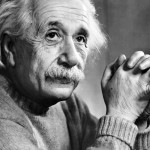


Albert Einstein
on Oct 2, 2015