Justin Rose
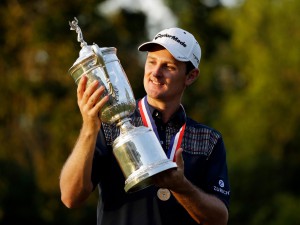
Justin Rose strikes a pose–head back, arms outstretched and palms up–as if awaiting something big. As several photo assistants toss handfuls of rose petals above his head and a shutter goes off, Rose gets watery-eyed trying his best not to blink.
After each shot, the photographer studies the digital image on the back of his camera and says things like, "Almost, but the pattern's a bit too dense," or, "This one would have been perfect, but there's a petal blocking his eye. Just a few more, Justin."
It's not the sort of detail work young millionaire athletes are known to tolerate for long, but Rose shows no trace of annoyance. All the more remarkable because herniated discs in his lower back–which had already caused him to miss more than a month of the 2007 PGA Tour season and would in a few days require a trip to a specialist–are making him stiff. But he doesn't balk when asked to place his head through a makeshift wall of roses, requiring him to stay in a slightly stooped position. The effort eventually elicits a couple of grimaced stretches and finally Rose's version of a tantrum: a quick look at his watch.
No doubt Rose's patience reflects the upbringing he received in the English suburb of Fleet, 40 miles southwest of London. "Justin has always had very good manners," says his mother, Annie. "We imposed discipline, and he seemed to welcome it." Surely the lessons have been reinforced by golf, because if Rose has been forced to learn anything in his nine years as a professional, it has been how to wait.
Of course, when he made history by tying for fourth at the 1998 British Open as a 17-year-old, it was as if all of British golf had been waiting for him. Comparisons with Tiger Woods were rampant, and Rose was declared the long-overdue successor to Nick Faldo. But after turning pro the next day, Rose missed 21 cuts in a row, perhaps the worst baptismal nightmare for a high-profile young player in the history of the game.
Rose's greatest feat might always be the way he emerged from the void in 2002 for his first professional victory, in his birth country of South Africa. But at almost the same time, Rose learned that his father, Ken, who had placed a plastic golf club in his hands at 11 months old, had leukemia. Rose won three more times that year, presenting two trophies to his father in his hospital room while earning the third with a frail Ken Rose in attendance. But it's hard to refute that his father's death at age 57 in September 2002 had a role in a four-year stretch of winless and mostly disappointing golf, dropping Rose out of the top 100 in the World Golf Ranking.
At the same time, and despite Rose's head start, a group of 20-somethings were moving into the top echelon of the game. Adam Scott, Geoff Ogilvy, Luke Donald, Trevor Immelman, Paul Casey, Sergio Garcia, Aaron Baddeley and Charles Howell III all have better credentials and, in most cases, flashier abilities. Rose has yet to win a PGA Tour event, play in the Ryder Cup, or make lists of the best players yet to win a major. And though his work ethic is at least the equal of anyone in the group, Rose, relatively speaking, waits.
Under the guidance of swing coach Nick Bradley, with whom he began working exclusively in May 2006, Rose's game has reached a new level. His comments have also become less self-effacing, in part because of the influence of the brash Bradley, a Brit who told the media, "There is no question in my mind that Justin can beat Nick Faldo's record of six majors."
Now, Bradley explains, "I said that because I see in Justin the 1989-'90 model of Faldo: a precision player who's a superior manager. But there's another reason. In Britain, we are almost ashamed to say, 'I want to achieve.' It's earmarked as being pompous and arrogant, incredibly bad manners. That's a value I–and Justin–can do without."
Though the Faldo comparison probably induced a momentary facial tic, Rose did not disassociate himself from his cheeky mentor. "It's quite true that what Nick said is not very English," he says, clipping his syllables like a lob wedge off a tight lie. "Some might frown on the American bravado, but in athletics, I've come to favor the American way. That bold self-belief is what it takes."