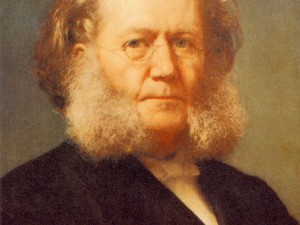
Curriculum Vitae – HENRIK Ibsen (1828-1906)
Henrik Ibsen – Norwegian playwright, essayist, one of the founders of the Norwegian National Theatre, as well as the European new drama – was born in Southern Norway, the small town of Skien, situated on the banks of Christiania, March 20, 1828 was a descendant of a noble and wealthy family of Danish origin.
When Henrik was 8 years old, his father, to do business, went bankrupt, and the collision with the human hardship and cruelty has left a huge imprint on the further biography, including creative. In school, he wrote beautiful essays, had a penchant for painting, but was forced to make a choice in favor of the profession, to ensure a more stable and significant income.
Fifteen-year teenager Henrik Ibsen left his native Skien, arrives in a small town Grimshtadt, arranged to apprentice pharmacist. All 5 years of age who worked in a pharmacy, he wanted to pursue higher education. Life in this provincial town, where free-thinking and passion for revolutionary ideas against him public. completely sick of him, and he went to Christiania.
In this period of life is the first writing poetry and drama “Catiline”(1850), had no success. We do not have brought fame and a few poems and dramatic satire that Ibsen published in the weekly, founded by himself, together with his friends. His new friend, Ola Boole, the founder of the national theater in Bergen, invited him to work the director and the director. Bergen biographies period was marked by writing plays, based on Scandinavian folklore. Staged at the local theater play”Pier Sulghauge” (1856) by Henrik Ibsen glorified all over the country.
In 1857, he made his move to Christiania, where he also worked as a theater director until 1862 In 1858, the playwright successfully marries, his family life has always been very prosperous. Procure himself a writer in 1864 retired, disillusioned with nationalist ideas, trying to find a new artistic forms instead limiting his former schemes and patterns, Henrik Ibsen went abroad, first to Rome, then to Trieste, Dresden, Munich – just outside his native Norway writer spent a quarter-century. European glory he brought dramatic poem “Brand”(1866) and the philosophical and symbolic drama”Peer Gynt” (1867).
Plays “Pillars of Society”(1877),”A Doll’s House”(“Nora”, 1879),”Ghost”(1881),”Enemy of the People” (1882) make the playwright Henrik Ibsen’s world-class. All these works have in common ostrosotsialnye reflection of reality. However, in the mid-80s the social intensity becomes less pronounced, the works become more symbolic and psychological. Ibsen victoriously marched on the stage of the theater in various parts of the globe. In 1897 in Germany it was established itinerant theater, which played only his works. Protracted serious illness undermined his strength, May 23, 1906 the playwright died in Christiania.